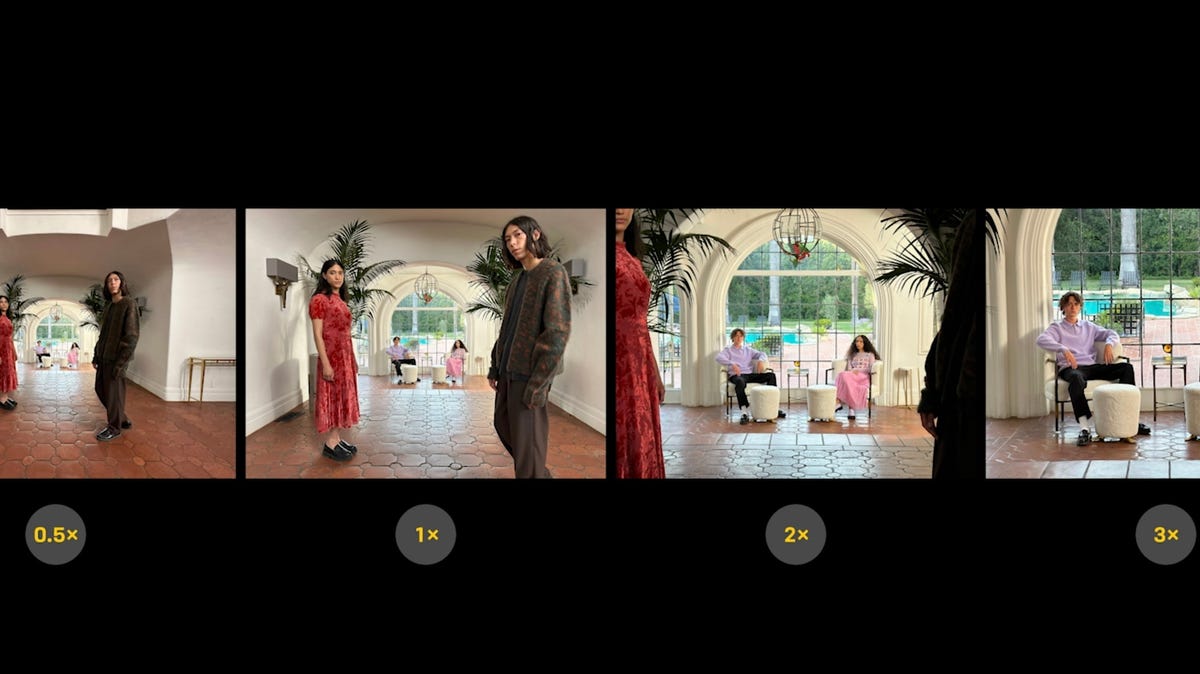
I am bored. How is it possible ? I mean, seriously. Apple today announced emergency satellite service, a Apple Watch which is also a dive computeran iPhone with a 48-megapixel sensor and an always-on display, and Second-generation AirPods Pro this apparently cancels out twice as much noise (but probably won’t cut out my pup’s yelps).
Still, I’m bored. None of this is unexpected. None of this rocks my world. None of this seems like the impossible made possible.
Admit it. You’re a little bored too. And yeah. It’s incredible. We’ll explore why after reviewing the ads.
Quick Announcement Summary
Let’s briefly check what was announced. Others here on ZDNET cover the details of the Apple Far Out event in much greater depth. I just want to touch on them to give us some perspective.
Apple announced the iPhone 14 series, the Apple Watch Series 8 and Ultraand a second generation of AirPods Pro.
The iPhone 14 (in Basic and Plus sizes) adds some photo functionality, but the highlights are two safety features that might seem somewhat niche: the ability to send a call for help via satellite and collision detection.
The iPhone 14 Pro (in base and Max sizes) does silly stuff with the notch, renaming it the dynamic island. It’s hyperbolic, but it’s actually quite an elegant user interface. Pro models also feature satellite SOS and collision detection, introduce always-on display capability and include even better cameras than last year.
Also:New iPhone models compared: which one to buy?
The second-generation AirPods Pro are perhaps the least compelling based on a pure spec sheet. Yes, the sound quality is better. Yes, the noise cancellation is better. But until you put them in your ears, you won’t really be able to take full advantage of the improvements. The AirPods Pro are good enough already, and the improvements should make them even better. Good.
And then there’s the new Apple Watch. There’s a spec bump for the more affordable Apple Watch SE. The Apple Watch Series 8 gets a temperature sensor, specifically focused on women’s health.
Also: AirPods Pro (Gen 2) vs AirPods Pro: Are they worth the wait?
Add to that the $799 Apple Watch Ultra, not as expensive as we thought, a rugged Apple Watch designed for adventurers and klutzes. It has dual-frequency GPS, so you’re more likely to connect to a satellite in cities or in mountain canyons. The battery lasts for days, a feature long requested by just about everyone. And the thing is even water resistant enough to double as a dive computer.
So here is. Some new features. Maybe some new stuff to buy. Yawn.
Image: Apple
But think about that yawn for a minute
Let’s take a step back. Let’s take a step back. Apple has introduced iPhones every year since 2007. MacTracker lists 38 models, including multiple models designed for different carrier systems at the start. The four introduced today will bring it up to 42.
The Apple Watch only arrived on the scene relatively recently in 2015, but it’s become ubiquitous on the wrists of millions of us.
Apple’s first external audio system was the product called AppleDesign Powered Speakers, dating back to 1993. But AirPods have only been around since 2016 (AirPods Pro since 2019), but AirPods have become iconic in the years since.
In the 15 years since the launch of the iPhone, not only has the device changed dramatically, it has dramatically changed our world. We had smartphones, but once the iPhone (then Android) arrived, BlackBerry and Palm Treos devices were consigned to the dustbin of history. Apps and always-on broadband gave us Uber and Instacart and the gig economy, and mobile-first computing, and so much more.
The original iPhone had 4GB of storage, a 3.5-inch screen, and a resolution of 320 x 480 pixels. This first model didn’t even have App Store apps. It had a 2 megapixel camera on the back. Selfies weren’t even a thing yet.
Today Apple announced a phone capable of taking 48-megapixel images. This iPhone OG could take a photo of only 1600 x 1200 pixels, and its quality was, to be charitable, OK.
Today, the new iPhone 14 Pro Max has a display resolution of 2796 x 1290 pixels, three 12-megapixel cameras and a 48-megapixel camera capable of taking images with camera quality that can only be described as beautiful. To be fair, smartphones with 48MP cameras have been around for nearly four years, but Apple’s new implementation is sure to be top-notch.
All that without talking about CPU performance, image processing performance, machine learning performance, memory and whatnot. The thing is, if any of us got an old stock iPhone, or even the iPhone 3G a few years later, we’d want to throw it against the wall in frustration. We have come this far.
Also:iPhone 14 Pro vs iPhone 13 Pro: Is it worth the upgrade?
But since we’ve come this great distance year after year, upgrade by upgrade, the incremental improvements don’t seem that great. For example, the camera features aren’t quite enough for me to throw away my iPhone 12 Pro Max and buy one of the new iPhone 14 models.
The AirPods Pro are already so good that in my opinion the improvements to the AirPods Pro 2 don’t warrant an upgrade (although if people report that they’re able to cancel dog yelp, I might give it a try). ‘consider).
I still use my Apple Watch Series 4 which I bought as a refurbishment in 2019. While the autonomy and robustness of the Apple Watch Ultra intrigue me (less for mountaineering and more for surviving the workshop ), my current watch works perfectly fine. I’d like to try to hold out until an Apple Watch comes out with constant blood pressure monitoring and other health sensors.
It’s the safety features that stand out
On the other hand, don’t assume that Apple’s advertised safety features only apply if you’re climbing a mountain.
Image: Apple
In 2019, Hurricane Irma was hitting my house, which by all reports was ground zero of what was expected to become a Category 5 storm. So my wife and I packed up some belongings, my MacBook Pro, a few iPads and our pup in our aptly named Ford Escape and we were out of town.
I’ve driven across America many times, and while much of America looks like central New Jersey, much of it also looks like the surface of the moon. There’s a moment when you’re speeding down the highway when you realize you’d better have enough gas in the tank, because the next gas station is a hundred miles ahead of you, and the last one was at hundred miles in your rear view mirror. And, of course, there are no cell towers.
You are completely alone, with all your life, your family and what may remain of all your possessions in a 10 year old car driving on an open and empty road. At times like this, it would be nice to know that your phone can reach 22,300 miles straight, no matter how desolate, to a geosynchronous satellite and call for help.
When traversing the Rocky Mountains, on very narrow winding roads with very steep inclines, it would be good to know that if something horrible happened, your phone could detect the accident and call for help.
Hopefully these are features you will never have to use. But as my ZDNET pal Jason Perlow pointed out at the start of his Apple Watch ownership, sometimes bad things can happen. When your watch or phone saves your life, it definitely justifies the investment.
There’s not even a lot of investment. The rumors were full of speculation that the price of iPhone 14 would increase. But the base iPhone 14 is still priced at exactly the same $799 as the base iPhone 13 last year. Now he can talk to satellites.
We’ve come a long way
We, and our technology, have come a long way since Steve Jobs wielded that first iPhone. Smartphones have changed our world in small and huge ways, in beneficial ways, as well as in dehumanizing and discontent-fueling ways. We are all a bit closer to each other in terms of being able to share our thoughts and opinions, which paradoxically has distanced us from each other in terms of civilized speech and a sense of camaraderie. Hopefully our technology will help us find creative ways out of some of the mess we’ve gotten ourselves into.
The way it can do this is probably through changes, rolled out bit by bit. Every incremental change is just that: incremental. A little more autonomy. A processor that processes instructions a bit faster. A slightly brighter screen. A little smaller notch. A camera that takes slightly higher quality photos. Transition from 4G to 5G. Some additional sensors. Another way to keep us healthy.
Image: Apple
It became a cadence. A regular and annual event. Of course, phones will be faster. Of course, the battery life will be longer. Of course, the cameras will be better. Thousands of engineers, designers and programmers are hard at work around the world, so that we can receive what we believe is our due.
“Bring us innovation”, we command. “Make devices better and more powerful”, we direct. “And try not to bore us again,” we pontificate disdainfully, as if we were rulers at court, talking to court jesters.
“Entertain us”, we insist. “Astonish us”, we ask. “Oh, and try not to raise the price.”
So what do you think? Are you bored or surprised? Will you buy a new iPhone, an Apple Watch or a set of AirPods Pro? Let us know in the comments below.
You can follow updates of my day-to-day projects on social networks. Be sure to follow me on Twitter at @DavidGewirtzon Facebook at Facebook.com/DavidGewirtz, on Instagram at Instagram.com/DavidGewirtz and on YouTube at YouTube.com/DavidGewirtzTV.